New Releases – June 2026

While my slacking on releases continues, luckily the same is not true for the other members of Demonic Productions. Here’s a small batch of releases for June 2026:

First up, Opicron. Our biggest release in a while, by far, is Opicron’s new door game, in which players on a small island manage colonies and compete for limited resources. Its gameplay may be familiar to those who enjoy board games, combining resource management, strategy, and negotiation with other players. Users can compete head to head against up to three other players, and there’s also support for bots with three different skill levels. It also connects to a central server for a wider pool of potential players. Nice!
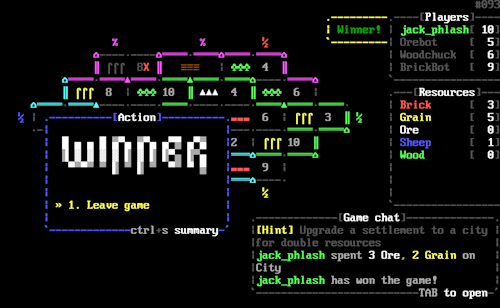
me beating op-ctn11 for the first time!

Coded in Python, this game supports a few different methods, including launching via Mystic’s embedded Python2 or Python3, launching via Python as an external program and reading the DORINFO1.DEF dropfile, and also operating as an actual DOOR32.SYS door. This has been tested in both Windows and Linux with multiple BBS software packages. This is a pretty damn cool release. Give it a spin, and let us know what you think!

Opicron also brings us an 1.1 update to his LastCallers MPY script for Mystic BBS. This mod is a last callers replacement featuring additional stats, a scrollable caller list, and is fully customizable. It also supports both traditional 80×25 as well as 132×37 terminals. For Mystic 1.12 A46+ with Python 2.7. Version 1.1 makes some optimizations to how terminal details are stored to speed things up a bit.

The man, the myth, the legend xqtr also rings up a trio of new releases.

HEXBIN is a little utility written in Python3 to view binary files in hex format, but with one twist. It’s intended to be used with structured data files, and highlights the bytes depending on what data structure they belong to. Very handy for reversing engineering old software, particularly all of that beloved 90s BBS stuff, so often coded in Borland Pascal, in which using structured binary files to store configurations and other data was the norm. Speaking of which, this release also includes Rec2Struct, a bonus script that converts Pascal record structures to Python record structures!
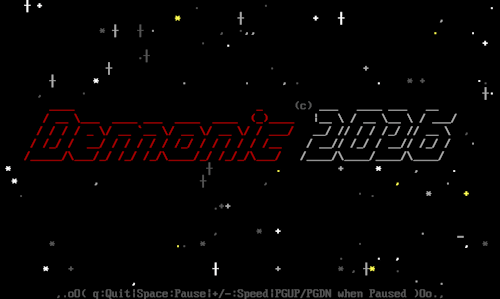
xq-stfs in action. trust me, this looks much scroll when its scrolling and the stars are animated!

A follow-up to his popular Mystic Screensavers script release, his v2 release includes 4 new MPY based screensaver scripts: three plasma effects and one cool fire effect. As with the original release, it comes with short but sweet instructions on how to modify your existing menus to make these scripts function like actual screensavers using Mystic’s TIMER function. Equally playful, xqtr’s Starfield TextFile Scroller is a MPY based Mystic mod that scrolls text from bottom to top while a starfield twinkles in the background, kind of like those famous Star Wars opening text crawls. Very cool!

Both of these releases are for Mystic/Linux, but that’s mainly because they were written and tested under Linux. They can be easily adapted to Mystic/Windows: all 5 scripts contain a statement to combine all of the rendered lines to output them that inserts a “\n” to add line feeds between lines. Something like “write('\n'.join(output))” If you change “‘\n'” to “‘\r\n'” to add that good old carriage return it should output as intended. Additionally, the Starfield TextFile Scroll contains numerous uses of “quit()” to exit the script. In Linux this returns users back to the BBS, but in Windows it will kill the entire session, disconnecting the user. This can be fixed by removing the “quit()” at the very end of the script and replacing other instances of it with “break”. This may need a tiny bit more tweaking, but generally, that should do the job.

More releases soon!
New Releases – January 2026

Ooooooh, a fresh batch of Demonic Productions releases! Well, sort of fresh. While this is our first release push of 2026, we’ve developed a bit of a pattern in that usually announcing a batch of new releases inspires us to work on finishing up others, so many of these were actually completed not long after the last batch in 2025. Funny how that works. Anyway, let’s get to it!

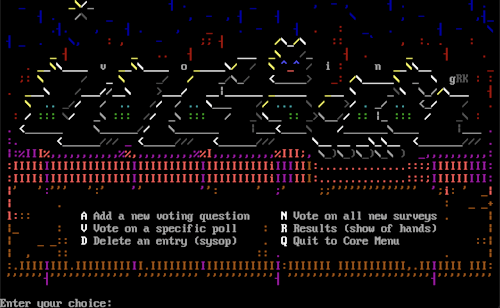
esc's voting door for daydream/linux!

First up, esc brings us a new voting door for Daydream/Linux. This one is fully featured, all original, and of course, includes its c source code. It also features some awesome old school ASCII goodness by griskokare of Legacy Crew, donated by Hawk Hubbard prior to his passing. RIP Hawk!

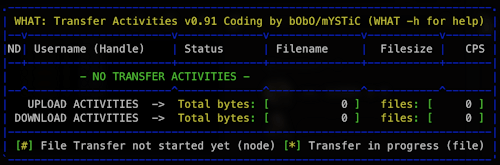
Continuing his noble and seemingly endless quest to fix and otherwise update classic Daydream mods/doors to get them to work to compile and often just plain work on modern systems, he’s got four more releases under his belt. First up is cheesewarn v0.3. A rewrite of a mod by jupiter8 of STF that displays a warning about users who haven’t been logging in frequently enough. Next is Menace Status Door v1.0. Originally by moondog and fenriz of menace, this is a rewrite of a nice little status screen mod. saturnvalidate v1.0 is another update of a jupiter8 joint. This mod shows a list of all new users, with the intent of letting your system’s other users vouch for them – perfect for your login sequence. Finally, we have WHAT v0.93, originally by bObO of mYSTiC. This slick little door shows what (heh) files are currently being being transferred. Perfect for more file focused Daydream boards.

esc's WHAT file transfer status for daydream/linux!

Finally, something a little bigger and not solely for Daydream, esc brings us his BBS Firewall (bbsfw). Written totally in Node.js, bbsfw is intended to provide a front-end for telnet BBSes, supporting many of the advanced features found in newer BBS software that older ones and other methods of hosting older software wouldn’t normally have, such as total connection limits and time based/connection rate limits, temporary blocking, connection timeouts, IP address whitelisting and blacklisting, filtering by country, detailed logging, and even an SSH proxy. esc has been working on this for a while now, but v1.20 marks its first Demonic release. While we’ll continue to put out any larger releases/updates, you can also check out his GitHub repo.

Next up, we have Lights Out v1.1 by xqtr. This is an enhanced version of the door game we released back in September. This one includes a couple of major bug fixes which would have made the door non-functional in a lot of situations, an unfortunate side effect of the fact that this door has been built using xqtr’s new XDoor v4.00 door kit, which is essentially our old warhorse of a Pascal door kit, XDoor 3.01, with a bunch of new units filled with even more awesome functions for you to use in your doors. While XDoor4 itself will be coming soon, this release will hopefully not only make Light’s Out work as intended, but also includes a Win32/door32.sys binary in additional to the DOS one and greatly expanded setup docs. Special thanks to Shurato and Exodus on Zer0net for reporting these issues and helping test the fixes!

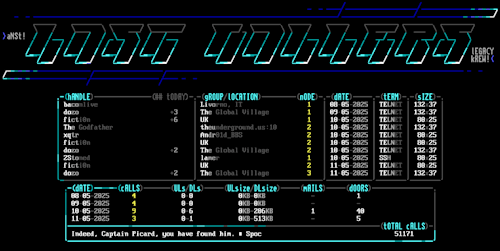
opicron's lastcallers 1.0 for mystic bbs

Last but certainly not least, Opicron makes his Demonic debut with LastCallers v1.0 for Mystic BBS. Inspired my xqtr’s AmiCaller Ami/x style MPL mod from 2017, LastCallers is a full MPY last callers replacement featuring additional stats, a scrollable caller list, and is fully customizable. It also saves its data in JSON, intended for longer term and more versatile storage of last caller data. Oh, and it supports both traditional 80×25 as well as 132×37 terminals – widescreen support, baby! For Mystic 1.12 A46+ with Python 2.7.

Before anyone asks, despite having several new goodies close to being ready for release, I’m personally not included in this batch as I hadn’t had much free time to work on any modding or development for the last half of 2025. That situation should be over, however, so I’ll be diving back into getting those things completed very soon.

GitHub Releases and You

Happy New Year! Good god, where has the last year gone?! I’ll be putting together some more exciting stuff very soon, but for now, let’s get super serious.

The traditional mindset of having larger, infrequent software “releases” has been slowly replaced by a more continuous integration minded approach favored by the now ubiquitous GitHub and similar platforms. While more and more hobbyist developers take the hands off stance of just treating their code as “live” these days, from what I’ve seen, most of us are still maintaining version/build numbers and documenting changes even if not packaging our releases. Why not have both? GitHub has a feature called “Releases” that allows for just that.

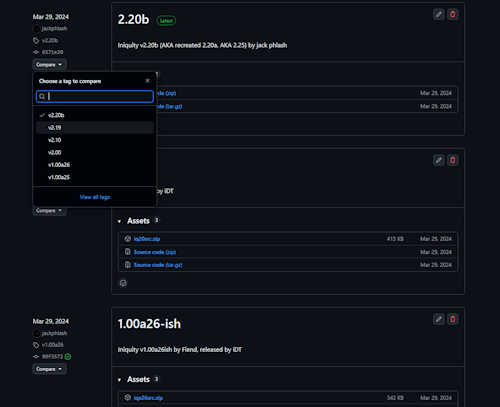
Looking through versions of Iniquity BBS

Releases are actually enabled by default, so unless you have it disabled you probably already see it, just sitting there empty, begging for some attention.

To get started, just go to “Releases” and click “Draft a new release” and…

  • Give the release a tag (I usually just use the version number, as recommended.) You can use whatever method of versioning you want – GitHub doesn’t care.
  • Pick the target – by default this will be your current master branch, but you can also target other branches and/or specific commits too.
  • You can then give your release a title (again, I keep it simple with the project name and version number) and your release notes, release announcement, etc. You can keep this brief or go as in-depth as you want here.
  • Finally, and this is one of the features that makes this really awesome for those of us in the BBS scene and other, similar hobbyist niches, is the ability to attach files to the release. While an archive of the source code for target commit will be included, you can also attach pre-compiled binaries, or better yet, manually package your release the old fashioned way and attach it here.

The end result is that you have a snapshot of the source code of a specific version, the associated binaries and/or release archive of that version, along with whatever release notes and other details you want to include, all in one highly visible place. It’s also all automagically associated appropriately within your repo – you can even do diffs/compares between these “releases” making it incredibly easy for you and your users to see what actually changed between versions (instead of relying on whatever half-assed notes you put in your “whatsnew” file.)

Here’s the official guide to Releases from GitHub and for a random example of someone from the BBS scene who is using this feature, check out Icy Board’s repo.